Reading & Writing
Chapter 5 of “Animated Storytelling” by Liz Blazer talks all about color and how it can be used to help drive home the idea behind an animation. Blazer says color can communicate the mood of the story and enhance the meaning. When talking about colors in animations, hue is the common color name, like blue or red. Saturation is how intense a color is and value is the relative lightness or darkness. Tone related to value, but it is more about the overall brightness or darkness of an entire scene. A color script can be used when animating to help outline what colors a designer wants to use. They must balance what looks good in each scene with colors that contribute to the story. Pre-color scripts are storyboards represented by rectangular bars with colors that match the big parts of a story. This pre-color script can help decide the colors for the full storyboard. Blazer also gave tips on using colors in animations. She says to limit the color palette and use saturation carefully to avoid overwhelming the audience. She also says to add an unexpected color at an important moment to give it emphasis.
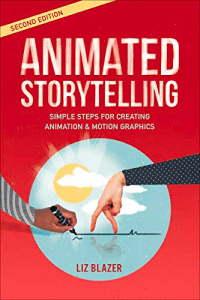
Chapter 6 focuses on the weird science involved in animation and how important it is to experiment. Blazer says experimentation makes every animation better, and it all starts with creating bad art. This helps an artist relax and stop worrying about what people will think. She says to go against your instincts and make a mess to try something new. Then you can add experimental ideas into the storyboards of a project. These experiments can involve technique, design, movement, transitions, sources, sound, and more. Blazer also says making unique animations is what gets artists hired.
Research to Inform
Create
Stop Motion Animation Pre-Production
After my research, I came up with two ideas for stop motion animations. The first is a linear story, which has a beginning, middle, and end. I chose to show a cloudy sky become a rain storm. Then at the end, the sun comes out. It will be made with paper cutouts and edited with music and sound effects to match the action.
My other idea is a nonlinear story using the book ending style. This means the start of the animation looks just like the end. This idea is
Stop Motion Animation Test
Using my iPhone and the “Stop Motion Studio” app, I easily created an example of a stop motion animation. I put my phone on a tripod and took pictures through the app as I moved plants along my desk. It helped me get a better understanding of what needs to be done to create a stop motion animation. After editing the pictures together, I can see the camera seems to move a little bit. I think the tripod may have been shaken when moving the plants.
 Katie Coen
Leave a comment