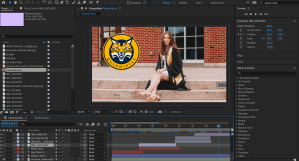
This week, I created an animated introduction to share more about myself using Adobe After Effects. Before getting started, I researched what I needed to be successful.
Reading & Writing
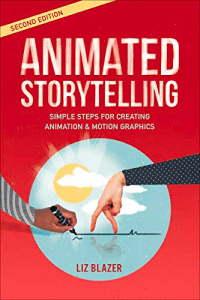
Chapter 2 of “Animated Storytelling” focuses on storytelling and the different structures that can be used in animations. Liz Blazer says animations are a great form of storytelling because there are no limits, meaning any ideas can come to life. Story structure is driven by beats, which are all the moments or active steps that move the story forward. The three-act storytelling structure is one form of storytelling. It’s a basic storyline where a character has a problem, they work toward a solution, then eventually solve the problem. The ending should relate to the theme and message of the story. In a nonlinear story structure, the story is not sequential, chronological, or straightforward. They follow their own set of rules and sometimes function without any clear character or plot. These stories require just as much planning. One type of a nonlinear story structure is a book ending, where the beginning and end of a story are the same. In a beaded necklace storyline, one sound is used to drive the story. In a countdown, the climax is established near the beginning, then is built up to with growing intensity. The puzzle story structure gives the audience a chance to solve a riddle as new information is revealed. A high concept story has a basic storyline, but is extremely strong and drives all the other elements.
Chapter 3 is about unlocking the story that will help create a great animation. There are two forms of this: narrative form and experimental form. Narrative form is the method of finding a conflict that provokes action to focus the story on. It’s a typical story with a beginning, middle, and end. The experimental form is used for unique and abstract stories because it breaks the traditional form. There are multiple different types of experimental forms, including visual music, where the artist translates sounds into moving images, shapes, and colors. The pure poetry method is used when an artist interprets a poem as a script and uses it to form an animation. Repetition and evolution is a method where a sequence of images is shown repetitively, but evolves with a pattern. When focusing on continuity and diversity, the artist will establish one predictable element that never changes, while an artist focusing on anthology will explore a theme through animation. And sometimes, the point of the story is just to make someone laugh.
Chapter 4 is all about storyboarding, which is the way animators plan their stories. They create individual frames of action that are usually drawn on paper in boxes. The storyboards lay out what will happen in the story and help make sure it is understandable. Thumbnailing is the first step of storyboarding, where rough sketches are drawn to work out shots and establish composition, framing, staging, and transitions. Then artists make real storyboards that capture all the action and emotion. A description or dialogue is also included here. When storyboarding, animators must think about shot composition to give the audience a variety of angles. They also think about framing to make sure the audience’s eyes are interested in certain things in a scene. Staging, which is planning where you put the subject in the scene, is also important. When planning animations, transitions and continuity are crucial. This is because anything can happen between two frames. Continuity involves the natural flow of visual information from one shot to another. Spatial continuity involves making sure an artist has established a consistent animation world. Temporal continuity is the consistency of logic in the story and directional continuity is about maintaining the direction of any action for an object or character in a sequence from shot to shot. Blazer says animations can be difficult to time, so she recommends using an animatic to find out. This is a video version of the storyboard strung together on a video software timeline. The dialogue, music, or voice over is added to mock the animation.
Research to Inform
My Personal Introduction
To practice the skills used by other animators in those examples, I created my own personal introduction animation using Adobe After Effects. I have used After Effects before, but I’ve mostly used templates from the internet. After watching the tutorials, I wrote a script, recorded it, and picked the music. I created a composition and got to work animating all the elements together. This was a time consuming project, but it was fun to be create and try out different transitions.
I chose to talk about my career along with my personal interests to give a well rounded idea of who I am and what I do. They are all strung together by movement using keyframes to make a continuous animation.
 Katie Coen
Leave a comment