
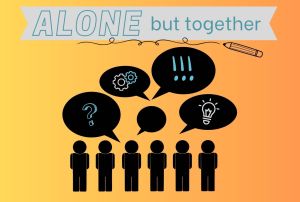
Some of the best experiences I have had working with a team aren’t all that conventional. Sitting around in a circle and calling out ideas to write on a whiteboard can be efficient for some, but the best ideas come from individuals working alone together. As descried by Jake Knapp in “Sprint: How to Solve Big Problems and Test New Ideas in Just Five Days”, Google Design Sprints can be used to generate and execute ideas quickly. It’s a five day process where a team spends their time coming up with ideas then seeing it through to a successful product. On day one, the team identifies the problem at hand and picks a focus. Then on day two, each person works alone to sketch their solutions to whatever problem must be solved. Day three allows for everyone to see and reflect on each others ideas, then making a decision on what exactly to test. A prototype is created on day four and its tested on day five with real people.
“The sprint gives you a superpower: You can fast-forward into the future to see your finished product and customer reactions, before making any expensive commitments.”
Google Venture
This may seem like a difficult process or a weird thing to wrap your mind around, but again and again, it has worked for corporations across the world. It users all team members strengths and creates an accepting environment to share them.
“Best of all, the process relies on the people, knowledge, and tools that every team already has.”
Jake Knapp
In my experience working at WFSB Channel 3, a news station in Connecticut, I’ve been in workshop meetings with other producers hundreds of times. Sometimes there is one manager who stands up and lectures or explains an idea they have, but other times, when the company wants to broaden their approach, they’ll let us all work together. I recall one specific training where we discussed what to do in a breaking news situation. After hearing from the managers for just a few minutes, they asked us all to jot down our own ideas on what to do in a senerio where news breaks and it needs to be shared in a pinch. Then they put us in groups, specifically breaking up the people they knew talked often.
Kevin Daum from INC says one of the best ways to generate great ideas is to work with people outside your normal circle. My managers used this tactic to get us out of our comfort zones, then we all came together to go through our group ideas. In the end, we made a detailed list of what should be done when breaking news comes in, and many managers said we had come up with ideas they never thought of.
Although we did not follow the five day process used by Google Venture, the workshop followed a similar plot of days one through three. It was a taste of a process that I know I can use in the future, whether facilitating or working with a group to come up with a plan for any topic. It’s a unique process that can solve anything, because as they say, no problem is too big for a sprint.
 Katie Coen
Leave a comment